Saladin's Crusade

During class on Thursday, we discussed the crusades that occurred in Jerusalem and the various groups of people that held control of Jerusalem. With that said, one thing that struck me was when Saladin and his army conquered Jerusalem, many of the rich Christians were able to pay their own ransom, but poorer Christians could not so Saladin's brother, Al-Adil released thousands of prisoners. This led me to want to research more into Saladin
Karen Armstrong writes that many of the prisoners were released "because Saladin was moved to tears by the plight of the families who were being separated when they were taken into slavery." Saladin however did not stop the selfish wealthy Christians who refused to help the less fortunate, as he needed the treaties and agreements to not be infringed on in the slightest. This led many Christians in the West to be aware of the "Christian" treatment Saladin showed the Christian prisoners (Armstrong 294).
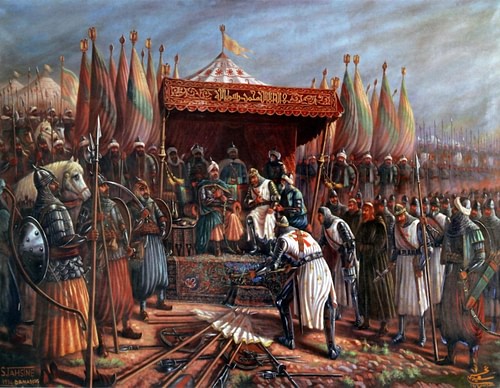
From 1174 to 1186 it is said that Saladin "zealously pursued a goal of uniting, under his own standard, all the Muslim territories of Syria, northern Mesopotamia, Palestine, and Egypt" (Walker). This was not done strictly through military force, as Saladin used his diplomatic skills mainly and military force only when necessary. Slowly Saladin became known as a generous, yet firm ruler, which explains his ability to not seek revenge and slaughter the Christians of Jerusalem.
The reason Saladin allowed Christians to purchase their freedom, rather than slaughtering them, as happened to the Muslims in 1099 was because the Christian defenders promised to leave the Muslim inhabitants untouched, as well as his devotion to Jihad and combating "wrongness."
Sources:
Armstrong, Karen. Jerusalem: One City, Three Faiths. 1st Ballantine Books ed. New York: Ballantine Books, 1997. Print.
Walker, Paul E.. "Saladin". Encyclopedia Britannica, 28 Feb. 2022, https://www.britannica.com/biography/Saladin. Accessed 27 March 2022.


Comments
Post a Comment